


Ask three vendors what an agency needs to put first-party data to work, and you’ll get three different answers.
A CDP (Customer Data Platform) vendor will say you need clean, unified customer data. A DSP (Demand-Side Platform) will say you need a buying platform that reaches every screen. Both are right. Both also leave a gap.
Agencies don’t buy platforms just to own them. For every client, they need to answer four questions: who to target, why, where to reach them, and whether they converted. The right tool is the one that answers all four with the fewest handoffs.
Here’s how CDPs, DSPs, and audience activation platforms like fullthrottle.ai® stack up.
Learn More About fullthrottle.ai® for AgenciesWhat a CDP Does (and Where It Stops)
A customer data platform, or CDP, is built to organize a brand’s customer data.
It pulls records from CRMs, websites, apps, point-of-sale systems, and email tools. It cleans them up, merges duplicates, and builds one profile per customer. From there, marketers can sort customers into segments, like lapsed buyers or high-value repeat customers.
That’s valuable work. But a CDP’s job mostly ends at the segment.
To put that segment in front of real people, a CDP usually hands it off to an activation partner: a DSP, a social platform, or an email tool. CTV, display, and audio all run somewhere else. Direct mail is usually a separate vendor. Measurement is often a separate project, too.
A CDP also works best with data a brand already has. If a client’s customer file is thin, or the goal is reaching new households, a CDP has limited ways to generate fresh first-party audiences on its own.
For agencies, there’s one more catch. A CDP is usually the client’s system. The agency may get access, but it rarely owns it, and every client may run a different one.
What a DSP Does (and Where It Stops)
A demand-side platform, or DSP, is built to buy media.
It connects to ad inventory across CTV, display, audio, and more. It bids on impressions, paces budgets, optimizes toward goals, and reports on results. For reaching people at scale, a DSP is hard to beat.
But a DSP is only as smart as the audience you give it.
Most DSPs offer some audience tools, like third-party data marketplaces and basic targeting. Bringing in a client’s own customer data is a different story. That data has to be formatted, hashed, uploaded or passed through a data partner, and matched to IDs the DSP can recognize. Every step can shrink the audience.
DSPs also stop at the screen. Direct mail isn’t part of the picture, so it gets planned, bought, and measured somewhere else.
And while DSPs report on delivery and the conversions they can track, tying ad exposure to offline sales takes more work. Think of a buyer who sees a CTV ad tonight and walks into a showroom next week.
The Gap Between Them Is Where Agencies Get Stuck
Put a CDP and a DSP side by side, and the gap is easy to spot.
The CDP knows who the customers are. The DSP knows how to reach people. Getting from one to the other can pull in half a dozen organizations:
- The client’s data team exports the customer file.
- The CDP vendor cleans it up and builds segments.
- An identity partner matches records to reachable households and devices.
- The DSP buys the media.
- A direct mail vendor handles anything offline.
- A measurement partner ties ads back to sales.
Each one has its own contract, timeline, and point of contact. When an audience shrinks or a report doesn’t add up, it’s not always clear whose problem it is. Usually, it becomes the agency’s.
That means moving files, chasing match rates, rebuilding the same audience for every channel, and stitching reports together after the campaign ends. It also means touching customer data the agency may never have wanted to handle, along with the privacy and security obligations that come with it.
The cost shows up in four places:
- Speed: Campaigns wait on file transfers and match processing before a single ad runs.
- Reach: Records drop off at every match, so audiences shrink.
- Consistency: Each channel ends up with its own version of the audience.
- Proof: Reports from different systems rarely line up.
Multiply that across every client and every client’s tech stack, and the agency is running a data operations team it never planned to build.
What an Audience Activation Platform Does Differently
An audience activation platform covers the whole path: data to audience to media to results.
fullthrottle.ai® is built this way. That long roster shrinks to one platform that builds the audience, runs the media, and measures the results. One partner to call. One audience across every channel. One place to see what worked.
The client’s data or signal goes in. What comes out is something an agency can use right away: first-party addressable household profiles, organized by behavior, service interest, and in-market activity.
That closes two gaps at once.
First, it fills the gap a CDP leaves. fullthrottle.ai® doesn’t just sort existing customers. It generates first-party audiences, finds households showing in-market signals, and can enrich them with second- and third-party data to expand reach.
Second, it fills the gap a DSP leaves. Those audiences don’t need to be exported, hashed, and re-matched before they run. They’re ready for activation across CTV, streaming video, display, streaming audio, and SmartMail from one workflow.
The agency works with audiences, not raw customer records to activate campaigns. It decides who matters and where to reach them. It doesn’t have to manage the data underneath.
See How Audience Activation WorksSide by Side: CDP vs. DSP vs. fullthrottle.ai®
Here’s how the three compare on the jobs agencies care about most.
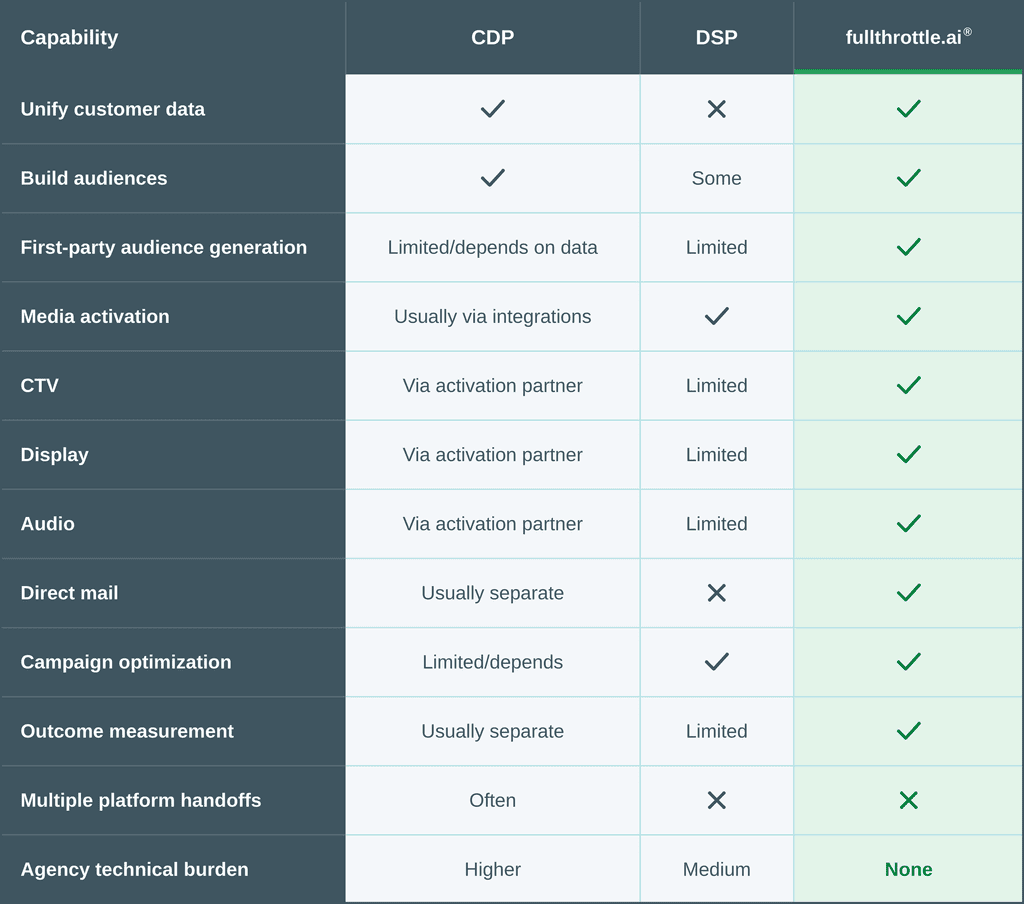
The pattern is simple. CDPs are strongest at organizing data. DSPs are strongest at buying media. fullthrottle.ai® covers both ends, with fewer handoffs in between.
Measurement That Closes the Loop
Proving results is where a patched-together stack struggles most.
When audiences are built in one system, activated in another, and measured in a third, linking an ad to a business outcome means more data sharing and more reconciliation. That’s especially true for CTV and audio, where engagement happens without a click. A household might see an ad on a streaming service and buy in store or online days later.
Because audience building, activation, and measurement run in the same platform, fullthrottle.ai® closes that loop. SafeMatch® Attribution connects media exposure to customer transaction data at the household level, so agencies can see which campaigns drove sales, appointments, visits, and leads.
Those results feed straight back into planning. Refine the audience. Shift budget to what’s working. Find the next households ready to buy.
Discover SafeMatch® AttributionSo What Does an Agency Actually Need?
The honest answer: it depends on the job, workflow, and client expectations.
A CDP makes sense when a client needs a long-term system for organizing customer data across its whole business. That’s usually the client’s investment, not the agency’s.
A DSP makes sense when the agency has strong in-house trading talent and the audiences are already built and ready to go.
An audience activation platform makes sense when the agency needs to get from client signal to live, measurable campaigns without building a data practice to get there.
For most agencies, that last one is everyday reality. They need to:
- Turn client data into audiences fast, without long onboarding cycles.
- Reduce exposure to raw PII and the obligations that come with it.
- Run one audience across CTV, video, display, audio, and direct mail.
- Prove that media drove real business outcomes.
- Scale across clients without adding a data engineering team.
- Agencies don’t need another silo. They need fewer handoffs between client data and real results.
That’s what fullthrottle.ai® is built for. White-labeled delivery keeps the agency in front of the client. AI-powered automation handles repetitive work in trafficking, pacing, optimization, and reporting, so teams can take on more clients without growing headcount at the same rate.
- When the DSP doesn’t cover the channel: activate audiences on channels the DSP doesn’t support, such as direct mail.
- When the audience still needs to be built: generate first-party household audiences from real in-market intent signals instead of relying on static third-party segments.
- When CDP data isn’t being activated: onboard CDP data as previous customer segments to power loyalty, retention, and win-back campaigns.
Fewer Platforms. Fewer Handoffs. Better Answers.
CDPs and DSPs both do important work. But on its own, neither one answers every question an agency gets asked:
Who should we target?
Why should we target them?
Where should we reach them?
Did they convert?
fullthrottle.ai® answers all four in one place. Client signal goes in. Addressable audiences, omnichannel activation, and measurable outcomes come out. The agency keeps control of strategy without stitching a stack together to get there.
Ready to see how it stacks up for your clients?
Request a Demo